


Information
KORAMKorea Institute for Rare Metals
Strategic Rare Metals
Background
An opportunity to facilitate early recovery from a crisis caused by lack of access to rare metals and augment the industrial structure with virtuous circle
- Price volatility, supply contraction, and intensified competition for demand → Increasing calls for measures to obtain self-reliance in rare metals
- Weak value chain in the material industry → Increasing demand for boosting up materials industry with enhanced research capacities and improving self-reliance in raw materials

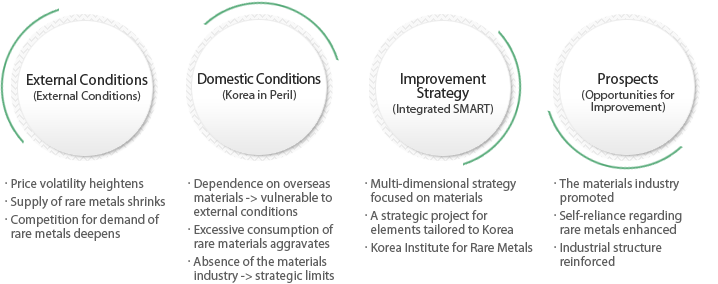
- External Conditions(External Conditions)
- Price volatility heightens
- Supply of rare metals shrinks
- Competition for demand of rare metals deepens
- Domestic Conditions(Korea in Peril)
- Dependence on overseas materials -> vulnerable to external conditions
- Excessive consumption of rare materials aggravates
- Absence of the materials industry-> strategic limits
- Improvement Strategy(Integrated SMART)
- Multi-dimensional strategy focused on materials
- A strategic project for elements tailored to Korea
- Korea Institute for Rare Metals
- Prospects(Opportunities for Improvement)
- The materials industry promoted
- Self-reliance regarding rare metals enhanced
- Industrial structure reinforced
Strategy
An opportunity to facilitate early recovery from a crisis caused by lack of access to rare metals and augment the industrial structure with virtuous circle
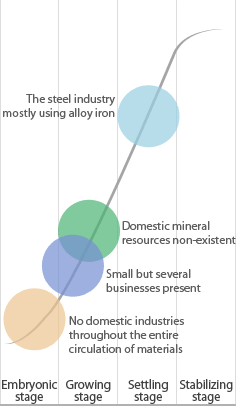
- Embryonic stage : No domestic industries throughout the entire circulation of materials
- Growing stage : Small but several businesses present
- Setting stage : Domestic mineral resources non-existent
- Stabilizing stage : The steel industry mostly using alloy iron
| category | resource | base material | intermediary material | recycling | |
|---|---|---|---|---|---|
| Industries Matured |
Nickel Chrome Manganese Molybdenum Vanadium |
X | O | O | O |
| · Domestic industries already exist, mostly using alloy iron · Mutual growth with the steel industry, the main consumer |
|||||
| Self-reliance in Sight |
Nickel Chrome Manganese Molybdenum Vanadium |
O | X | O | X |
| · Domestic industries already exist, mostly using alloy iron · Mutual growth with the steel industry, the main consumer |
|||||
| Infrastructure Being established |
Nickel Chrome Manganese Molybdenum Vanadium |
X | △ | △ | △ |
| · Domestic industries already exist, mostly using alloy iron · Mutual growth with the steel industry, the main consumer |
|||||
| Industries Non-existent |
Chrome Manganese Molybdenum Vanadium |
X | X | X | X |
| · Domestic industries already exist, mostly using alloy iron · Mutual growth with the steel industry, the main consumer |
|||||
| Types | Development Strategy | Expected Effects |
|---|---|---|
| Industries Matured | Securing overseas resources, strategic stockpile | Connecting the self-reliance regarding rare metals with demand Industrial infrastructure for new growth of expert enterprises |
| Self-reliance in Sight | Developing domestic resources, promoting base material industry, fostering recycling materialization | |
| Infrastructure Being Established | Reinforcing the materialization industry, materialization of reductive/alternative elements, recycling technology | |
| Industries Non-existent | Supply stabilizing, establishing infrastructure of the materials industry, introducing new technology |
Early transformation of five top-priority elements into growth engines→ Extended application of five priority elements in the near future.
- Identification of weak points in the material cycle of “resources-materialization-products-recycling” for each element → Completion of virtuous circle though obtainment of required technologies
* Technologies with priorities of development: 20 technologies (five top-priority elements in 2015) → 40 technologies (5+5 elements in 2020), and 10 world-leading technologies
| Items | Weak Points of Domestic Industries | World's Top Technology |
|---|---|---|
| Gallium | Ore→(Base materials)→(Intermediary materials)→Products | Materialization technology for high-purity large LED |
| Platinum | Ore→(Base materials)→(Intermediary materials)→Products | Homogeneous dispersion of high-functional hyperfine particles |
| Indium | Ore→(Base materials)→(Intermediary materials)→Products | Materialization technology for a large target with an alternative to indium |
| Tungsten | Ore→(Base materials)→(Intermediary materials)→Products | Low-carbon green refinement, technologies of alternative materials |
| Rare Earth | Ore→(Base materials)→(Intermediary materials)→Products | High-functional magnet materials for hybrid vehicles |
- For the elements with high instability of supply, which results from prospect of resource depletion and uneven regional distribution of reserves, it is an imperative to reduce the consumption of related elements and develop alternative materials and recycling technology → Facilitation of domestic self-reliance
| Fields | Examples | Effects |
|---|---|---|
| [Reduction] Materialization technology→ Performance improvement→ Reduction in consumption |
Reduction of platinum as auto exhaust catalyst | Decline in net inflow of platinum |
| [Alternative] General materials→ Development of new functions→ Alternative to rare metals |
Display made of alternative transparent conductive materials | Rare metals-free industry |
| [recycling] Scraps→ Waste materials→ Collection of rare metals |
Recycling of W and Co in the whole process of cemented carbide alloy | Recycling→ enhancement of self-reliance |
Strategic Measures
Multi-dimensional research development considering the following flow: target elements→ current status of enterprises→ level of technology→ ripple effects on the market
- Business model geared towards infrastructure building : To develop core strategic industrial technologies, centered around seed companies, and engage with consumer companies
- Business model without domestic industries (domestic product companies exist): To establish a pilot infrastructure through research conducted by both production companies and intermediary organizations → to expand the business of existing corporations and seek start-up corporations
- Business model for leading the industry: To use intermediary organizations as material supply bases for pioneering research (new products, reduced and alternative elements) → When mass-produced, developed products and materials can be useful for business advances of materials firms.
- To avoid sporadic support, common for current R&D business, and, instead, adopt multi-dimensional, simultaneous execution of strategy for early achievement of outcomes → To stabilize supply and maximize ripple effects on the industry through the omni-dimensional deployment of material technology and circulatory materialization technology for base materials of each element, intermediate materials, and reduced/alternative materials
| Category | Phase I (2015) | Phase II (2020) | |
|---|---|---|---|
| Items | Gallium, Platinum, Indium, Tungsten, Rare Earth Elements | Nickel, Lithium, Magnesium, Cobalt, Phosphorescent Rare Earth (Gallium, Platinum, Indium, Tungsten, Rare Earth Elements) | |
| Strategic Technology | 20 strategic technologies Global top 5 technologies |
40 strategic technologies Global top 10 technologies |
|
| Expected Effects | Specialized Firms | 49 companies | 112 companies |
| Job Creation | 2,400 jobs | 7,450 jobs | |
| Production | 5.9 billion dollars | 13.2 billion dollars | |
| Self-reliance | 56% | 79% | |